to my son
April 15, 2016 § 2 Comments
Last night we attended a lecture given by your childhood hero, Bill Nye. Walking through the unfamiliar space you began shrugging and snapping, staccato movements on a loop of increasingly rapid repetition; enthusiasm stemming through your limbs like joy tapped into a morse code of movement. In an auditorium crowded with thousands of science-minded fans, you sat at attention as if the room had shrunk to accommodate an audience of two.
Stowed away in my purse was a note you had written Mr. Nye when you were 5 years old. So many years ago I envied this man the fame that you might draft him a letter given your disinclination for writing, the physical demands of shaping letters against the tide of faster ideas often a burden of inconvenience. I reasoned that Mr. Nye must receive so many letters that surely your effort would be lost in his company and as such I should be allowed to keep this time capsule in your penmanship for myself.
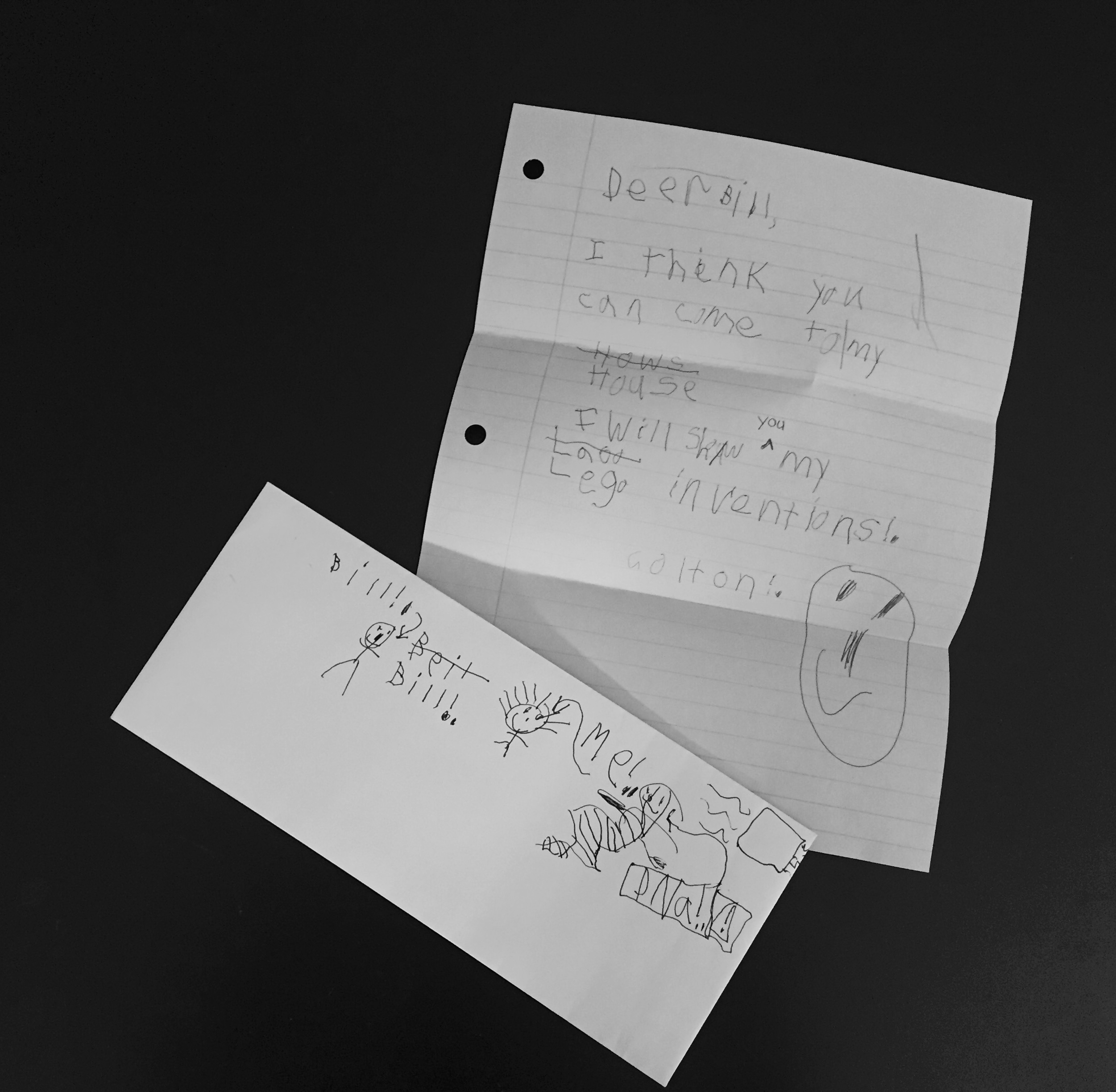
Yesterday I confessed my crime of hoarding a letter intended for someone else and had hoped you might gain a signature on the envelope, but the night did not lend itself to a private audience and we left the lecture for a leisurely walk. With long easy strides you casually forgave me my trespass and offered effusive thanks for the evening’s events.
It was enough to be present.
I think sometimes we all forget the luxury of this truth. So often we strive for dramatic performances of appreciation in celebratory moments, losing the elegance of a simpler delight.
In your letter you had invited your hero to play. Yesterday it was enough to find yourself in the same room.
This gratitude for what is and the ability to see wealth in less, it is such a small part of why I am so proud of you and such a large part of why I am better for your gentle lessons.
On the eve of a special birthday, I’m wishing you a lifetime of joy in small moments of mindfulness that you may always find enough within.
Love, Mom
to my son
February 24, 2016 § 4 Comments
On the days I worry about you, I marvel at the strength of character with which you navigate the complexities of your daily experience. The honest vulnerability of your words and the steadfast faith in self despite conflicting cultural messages of conformity that denounce diversity with lessons in mainstream manipulations.
Special education* is still a work in progress, measuring success too often by an ability to perform dominant expectations – “normal” behaviors. Inclusion is meant to create a space of acceptance, so why do we still discount the differences that inform a more genuine image of the world we live in?
There are books and speakers, all who commit themselves to crafting lessons on modeling neurotypical behavior, but what of the unexpected wisdom of your experiences? What are we to make of those uncomfortable reflections of “normal” that highlight an inequality in empathy and discrepancy in worth?
These are the days that must happen to you. – Walt Whitman
It would be nice if they didn’t. It would seem to me they needn’t. But, alas, they do and we are changed, often for the better, because of them. Messy miscommunications create a dialogue, however imperfect. Just as you are learning about others expectations of you, you are teaching others about your expectations of them; one conversation at a time.
I love that you stand up for your beliefs with a passion equal to the sincerity with which you listen to other’s perspectives. No matter how many times you are asked to concede to a majority expectation, you advocate for your unique experience of an alternative sense of normal.
Sometimes even I get distracted by my expectations without considering yours. After all, you don’t ask me to change, you simply fill in the gaps of my understanding with your truth – patiently and with acceptance for my ignorance.
I’m sorry.
I remember the first time you drafted a letter of apology. A school aide implied by her word choice that you had behaved in a way that was difficult or disrespectful. I asked you to own your behavior with a note of apology. In your elementary penmanship you did as I asked, but then you spoke to your behavior and intentions. The aide acknowledged to me the truth of your perspective and complimented your character.
Yesterday you were asked to write another letter explaining a classroom conflict with a new aide. Thoughtful penmanship and specific quotes spoke to the same honesty in your experiences; a willingness to own your thoughts and feelings, responsibly and without excuse, while holding others to their behavior as well.
I’m thinking of framing the write-up, not because you were right or wrong, but because your integrity and confidence are admirable qualities more valuable than mainstream social niceties. In a handful of sentences you apologized, valuing another’s expectations and emotions, while gently affirming your worth.
You were teaching even as you learn.
Love, Mom
*I want to take a moment to acknowledge and celebrate the individuals who have been remarkable companions in my Special Education journey. We’ve a way to go, still, but I’m a better advocate for my children for your knowledge and kindness. Thank you.
raising sheldon
January 26, 2016 § 8 Comments
If you have a child on the Autism Spectrum you are probably pretty comfortable with unexpected statements – some call them blurts.
I don’t love the word blurt, it sounds more like a bodily function and implies an absence of control that interrupts the peace leaving a foul impression.
Around our home unexpected statements are what keeps us on our toes, they create interesting tangents and spontaneous laughter. I’ve come to appreciate the honesty of my son’s speech and the innocence of his errors.
When he was little, my son would spout extravagant facts he’d memorized from the mountains of books that littered his days. I spent a decent amount of time verifying information with my own research so that I could participate in his interests.
This same natural ability created an entire vocabulary of funny one-liners from favorite books and movies. My son and husband could hold an entire conversation with direct quotes taken out of context.
Most days my son’s comedic timing and memory for details is a gift. Some days it’s a burden.
This week a store manager who my son’s school partnered with for practical exercises in social skill building determined it was too much work after my son commented on a customer’s groceries.
If you’re wondering what he said, I’m not telling. I don’t want to shame my son, the customer, or the store manager.
What he said, specifically, isn’t the issue. Some of his statements would make you laugh and others would make you scratch your head. There was one statement that I could conceive was mildly offensive, but most of them were simply misplaced.
I wish I could explain to the manager that my son’s blurts are more exaggerated when he’s nervous; that he will work over-time, verbally, to impress a stranger or make them laugh. Another week and the anxiety might have eased, reducing the instance of unfortunate efforts at humor.
I understand, I do. Unexpected statements present challenges, but they are also opportunities.
What might have happened if the manager stood up for the teenage boy with special needs and communicated to his customer and community that “we’re working on it.” What an awesome message one business might have made to a population of children, parents, and strangers of tolerance and empathy.
The last business did.
We’re going to be ok. Actually, we already are, but I’m sad for the store and it’s customers that they didn’t model the commitment their partnership with special needs families implies. Relationships require an investment in one another, work.
My son isn’t Sheldon Cooper, there is no laugh track to his impressive library of memorized facts or social fumbles. In the real world his embarrassments are not so easily written off and the laughter isn’t always kind.
I spend a lot of time talking to my son about others’ expectations, he’s spent years navigating social norms with the forced attention of a second language; to understand and connect in a world that does not always conform to his expectations.
This morning I wanted to speak on behalf of my son, hoping that maybe someone else might consider an unexpected statement an opportunity to exercise a different perspective and, maybe, a little patience.
artistic
January 15, 2016 § 2 Comments
In fleeting minutes of busy days, I have taken to indulging in borrowed time among old photographs; giving thanks for those images preserved in a cardboard box of jumbled memories.
Among these paper gems was a particular photograph that has captured my heart, a forgotten play day from long before our son’s Autism Spectrum diagnosis. There is joy in this discovery for a later memory, one not captured in print; a discussion with our elementary aged son and a cautious question of his understanding of Autism as so many adults introduced a new language to his vocabulary.
I wasn’t sure, then, what he understood and it was important to me that our son’s identity expand to encompass this new knowledge in a way that honored a heart, mind, and spirit greater than clinical terms and educational assessments. So, I asked our son if he understood what his diagnosis meant.
I know I’m artistic.
And so he is as he always was, a mystery of ability with not so unusual needs.
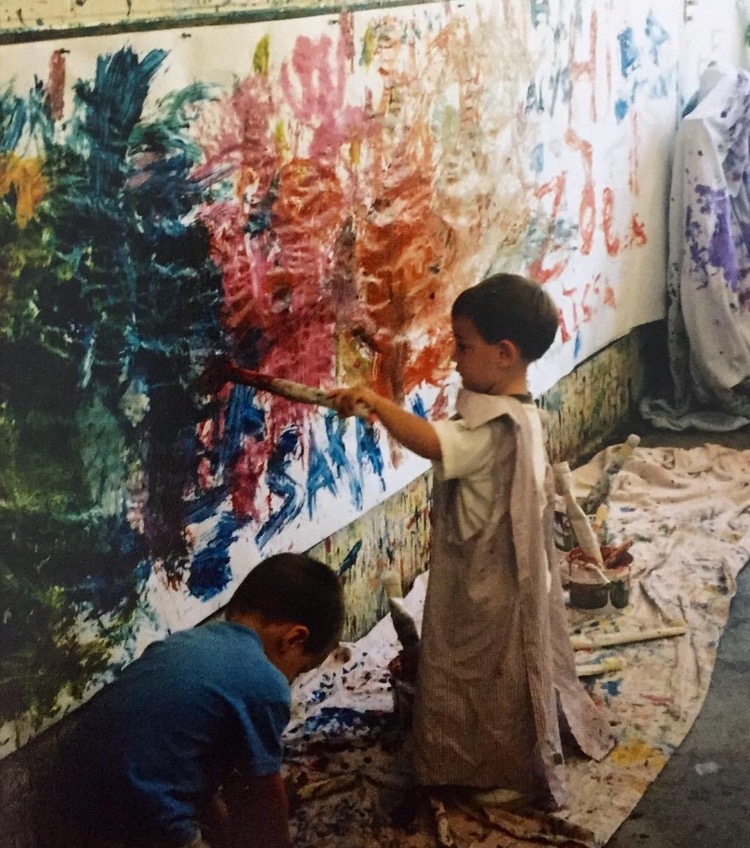
In ten years we have learned much, but it is the magic of the inexplainable that still best speaks to our son’s truth.
“The most beautiful experience we can have is the mysterious. It is the fundamental emotion that stands at the cradle of true art and true science.” ―Albert Einstein
sight & seen
June 18, 2015 § Leave a comment
I knew this moment was coming, it is an inevitability of our experiences. A handwritten message on a speech rubric, a casual note on eye contact. Except, for us, there is nothing simple about this encouragement; something in the words themselves strikes at a tender place. I have to remind myself that the author means no harm, but still I wonder if they understand the assumptions of effort in the critique.
To my son’s teachers,
There are years of patient practice in the art of looking up into the faces of expectation. My son does not meet this expectation lightly.
The young man who looks up, however inconsistently, has worked very diligently to do so. He does this to earn approval, knowing it is important to those he wants to please. He is emotionally invested in the effort, but the act itself is often a battle of wills.
Watch his body as he bends toward himself, the wheels turning as he debates eye contact over the internal pull to riffle through endless files of information he might extract if only you will forgive the social stumble as he navigates the cluttered cabinets that hold his thoughts. He’s looking to offer you a piece of himself, to gather his worth into something you might value.
When he remembers to look up, to please you, he’ll gauge you briefly for a hint of interest before scurrying back to his files.
If you smile, he’ll slip into comedy eager to draw more joy. If you look sad, he’ll forget his place, anxious to offer you comfort. If you look angry, he’ll shuffle into an assumption he has failed and retreat into his own disappointment. Every look means something uncertain and the weight of all those choices is sometimes insufferable. His hope is hidden in every sidelong glance, each fleeting glimpse to measure your expression for encouragement.
It is such a small thing, to be seen. Look tenderly at the young man you are asking to see and offer sight in exchange. If you smile, he won’t need a written reminder; he’ll mark his sight by your effort.
to my son
April 7, 2015 § 4 Comments
There is a moment from last week that I keep returning to; an image just askew of my periphery that pulls my eyes off task and towards a recent memory. It is a small thing, but in each remembering it offers a lingering delight.
We had just delivered your sister to a lesson and I had dragged you, to your great disappointment, on an errand. As I combed the store for the necessary items, I caught a sudden movement and turned to see you dancing. It’s the kind of performance most would leave for the privacy of their room, an exhibition I myself would probably reserve for the borrowed bravery of a rarely indulged second glass of wine. Uninhibited you snaked your way through the empty store intoxicated by the music.
I’ve spent so much of your life noting the social norms that it was second nature to entertain a lesson. The words felt bitter on my tongue, puckering my thoughts from the ease of the smile you had only just gifted me. I told you then how much I envy your reckless disregard for thoughtless rules that bind us to a hyperconsciousness for others’ opinions. If I were braver I might have danced with you.
We talk of dancing like no one is watching, but you live with a truer fearlessness. I hope you always hear the music in the mundane.
Love, Mom
awareness & acceptance
April 2, 2013 § 18 Comments
Today many will adopt social media identities in acknowledgment of Autism Awareness. Some will debate the value of aligning families and individuals with established campaigns to elevate consciousness with readily recognizable puzzle pieces; gathering individuals into a unified banner of blue. For our family awareness and acceptance are themes we celebrate daily, privately, among those individuals who see us not in shades of blue or missing pieces, but as individuals who are complicated and complete as is.
My son was the same little boy post-diagnosis that he was in the minutes before the word Autism seeped into our vocabulary. His life is linear, sometimes spiraling in its changes, but seamless in its fluidity. Incorporating our son’s diagnosis into our lives created an opportunity to understand pieces of our son more clearly and to lend support to enrich his experiences. We know him, first and foremost, by name not by complicated acronyms that outline needs.
In honoring the lives of those touched by Autism and the extensive collection of family, friends, therapists, and physicians who walk among us, I would ask strangers to open their minds to awareness and their hearts to acceptance with small acts of patience and compassion not only today, but daily.
crashing
December 12, 2012 § Leave a comment
Yesterday was enchantingly deceptive, my son’s evening unfolded with ease and I embraced a tiny measure of academic and social success greedily. Today, twirling through my errands my heart lighter for the simple joys of the day before I was off-kilter when a message from my son’s school caught me happily distracted, defenses down, entirely unprepared for reports of a day riddled with challenges.
While I was checking off last minute holiday errands and visiting with a close friend, my son had run off course at an alarming speed crashing into conflict. My ignorance was indulgent, the awakening abrupt. These moments when an unforeseen challenge mocks a quiet success I begin looking for markers, unraveling available information, trying to piece together a puzzle that might lend clarity and direction. Like a triage nurse I tuck away emotions to better evaluate symptoms, moving quickly to aide.
Today I sought a familiar voice of authority to share the school day’s challenges, guarding my worries behind self-depreciating humor and a smile, my mind working circles around the information. In a rare moment of unpredictable failing there was no easy, logical answer and that reality brought frustration and sadness in the quiet car ride home from school. Despite my best effort some days crash into others and leave me tender, ever mindful of challenges outside my control.
Tonight, as I set aside expectations and tip toe more cautiously around my hopes, I am mindful that my son stands in the middle of the chaos – misplaced and unaware. In truth, I envy his total lack of inhibitions; he is marching happily to a tune all his own and I must remember to hold tightly to his joy least I allow outside expectations to steal a genuine appreciation for his sense of self. He is mine and entirely his own, more beautiful for his flaws.
the work of play
September 18, 2012 § Leave a comment
Parenting magazines and childhood development books enumerate eloquently on the psychological and emotional benefits of play. Parents facilitate play dispensing it with the regularity of an essential vitamin, using play as a directive and alternately assigning it time slots in busier schedules. At twelve years old my son plays in a manner not unlike the parallel play common to young children, beside another rather than interacting directly with another. Play when left to his own endeavors is independent, when directed by us it becomes an exercise in navigating the social challenges of communicating with another.
Social practice sessions in formal groups often place my son in a circle of chairs using a partially scripted conversation. I tend to identify these as warm up routines, similar to the mundane act of playing catch in preparation for the big game. My son goes through the motions waiting to be called to the plate. When he doesn’t get invited to play, he retreats into individual interests.
Last night I watched my son exercise his social knowledge in a setting intended to be recreational. He was working at playing. I enrolled my son in a rock climbing class, aware this was an individual activity that highlighted a natural skill set, hoping perhaps he would meet another child that shared his interest. I was aligning chance in hopes of fostering a conversation and play.
On the first day of class I was pleasantly surprised to note that the only other child in his time slot was a familiar face from our past, a young girl also on the Autism Spectrum who we met in a structured social group a couple of years back. I recognized the mother from waiting room conversations and inwardly applauded our good fortune. Two children in need of practical exercises in play, sharing an interest and need, working through play.
Last night I watched my son and his peer guide one another up a rock wall, blindfolded, directing one another and encouraging one another over obstacles toward a goal. There could be no greater moment that witnessing this sharing. I fell asleep last night peaceful with the knowledge that this new experience with an old acquaintance is providing an essential, natural opportunity for my son to play.
a lesson in labels
August 31, 2011 § 1 Comment
At an early age my son was diagnosed with PDD-NOS and ADHD, a jumbled mess of letters, their meaning uncomfortable and overwhelming. Pervasive Developmental Disorder – Not Otherwise Specified, an Autism Spectrum Disorder, and Attention Deficit Hyperactivity Disorder.
I remember the moment of my son’s diagnoses with physical clarity. My body struggled to draw air while images of my son’s past and future flashed before my eyes; a conscious drowning. My heart heavy with fear for the future, my mind desperate for facts, my body achy with unexpressed grief; physically, mentally, and emotionally I wanted to reject the diagnoses. I worried doctors, teachers, family, friends, and strangers would compartmentalized my son’s spirit and unique mannerisms to fit in the confines of sterile, medical labels.
That day my husband and I promised one another to use our son’s diagnoses as tools for understanding him better and helping him live a full life. We endeavored to discuss our son’s needs honestly, without apology or shame. The first year of his diagnoses was focused on facilitating our son’s emotional, social, physical, and academic needs. Throughout that year we maintained a sense of privacy concerning our son’s diagnoses as we educated ourselves and made difficult decisions. It was important to us that we share correct information and make decisions free of others’ expectations and opinions. We had a small, close-knit support group consisting of physicians, psychiatrists, therapists, educators, family, and a handful of friends.
One year after the diagnoses we shared our news in the lines of a letter as we raised money to support Autism Speaks. Our son tallied the donations and read the letters of support that poured in, aware only of love and kindness from the multitude of faces that were a part of his life. It is with this experience that our son, at the age of 6, first told people he was Artistic. He understood part of his diagnoses meant he had a collection of characteristics typical of children on the Autism Spectrum, but speech delays created an endearing proclamation of Artistic. He would smile brightly at the revelation and continue on his way, unaffected and proud.
With the development of homework, we began to understand new challenges stemming from ADHD. We talked directly to our son and teachers, but less openly to others. Too often I found myself in the company of passionate debates concerning diet and medication. I honor others’ choices for themselves and their children, but wanted our family’s decisions to remain uninfluenced by popular opinions. It was the diagnosis we didn’t talk about.
Standing in line during my son’s Middle School visitation, a woman asked us for medical forms. My son, loudly and abruptly, declared to the woman collecting forms that he has ADHD and takes medication. I flinched at the stark revelation and instinctively looked around to gauge the reaction of those around us. I was still processing my son’s statement when a young girl behind us in a full voice announced she has Asperger’s and takes medication. Just like that, I felt eccentrically normal.
Years of tucking parts of our life into safe pockets of friendship and suddenly it felt okay to let go. My son likes who he is even if he doesn’t like his challenges. There was a lesson there in a moment shared with strangers. For all my efforts to see my son completely, it was my son that showed me he is whole.

